Slurping is a simple mechanism by which the drinker aerates the tea, a practice also common to wine tasting. The main difference here is that whereas in wine tasting the liquor is simply sloshed about inside the mouth, in tea tasting the liquor is slurped. Admittedly, some people do find the noise associated with the tea version bit unpleasant, but there is a purpose to it so bear with me.
Because slurping cools down the tea, it can be served and drunk hotter and faster. To me, however, experiencing the tea as fully as possible is always the primary consideration, and slurping works towards that as well. When tea is slurped, the aromatic oils it contains are sprayed all over the inside of the mouth, and while this may not provide a more fragrant cup per se, it noticeably alters the character of the liquor by emphasizing some characteristics and playing down others, sometimes dramatically enough to make what seem to be entirely new tastes emerge (depending on how much you choose to slurp). As an added benefit, I have found that slurping often mitigates the appearance of excessive bitterness or roughness in the aftertaste of many teas; useful for rendering an overbrewed cup more palatable.
These differences may seem fairly minor, but then to slurp or not to slurp was not the existential question posed by Hamlet. The tea experience is rich in subtle nuances, so slurp to explore (and once the tea has been swallowed, exhale deeply through the nose for a few more)!
Thursday, 30 June 2011

Thursday, 23 June 2011
Gu Zao Wei - Spring 2010 from World Of Tea
 Tea: Gu Zao Wei oolong from World Of Tea
Origin: Taiwan
Harvest: Spring 2010
I've often read about the profound effect the nature of the water used to brew tea has on the final beverage, and today I have a prime example. Gu Zao Wei is a tea that I used to think of as a pretty good example of a mid-roast, mid-oxidation oolong. A good all rounder to drink on a day-to-day basis, but nothing really special. This afternoon's was my first session with this tea using my new ceramic kettle, and it was a wholly new experience. The water coming out of the unglazed ceramic spout of my kettle made the tea come alive in a way I had never experienced with this tea before! This may be incentive to revisit some teas from The Before Time...
On to today's tea. The smells trapped by the airtight seal on the bag in which the leaves are stored are abundantly smooth and fruity-floral without too much evidence of roast; that particular character makes itself evident once the leaves are heated up.
 The first short infusion doesn't release much in the way of aroma from this tea, but what little there is is pleasant. This may seem a strange thing to say, but the tea feels wet in the mouth. It's not the oily thickness of a very green oolong, but just a refreshing feeling which coats the palate. This makes for a very interesting overall textural profile as this tea has a tendency towards being very mildly astringent. When I say very mildly astringent, I mean that it isn't quite enough to actually register as astringency unless you're really looking for a word to describe that nice, slightly cooling feeling on the tongue and across the rest of the mouth.
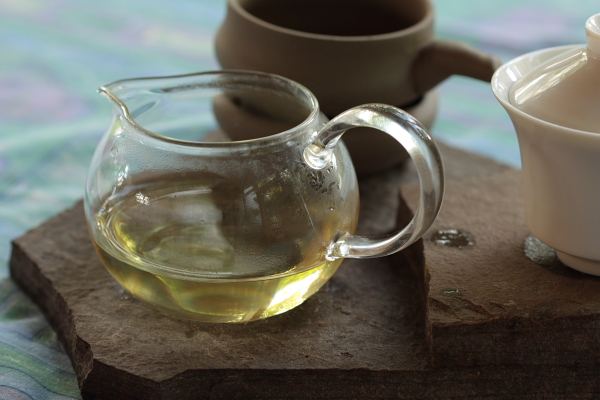 To me, this is an all-weather tea: slightly cooling on the days which are a bit too hot, and slightly warming on the days which are a bit too cold. The roasted character starts to emerge on its own as an undertone in the second infusion but never really comes to the forefront, leaving flavours of ripe fruit to occupy the limelight. On some level this tea is slightly sweet, a characteristic which comes out more in the aroma from the liquor itsself and even more so from the aroma cup. Whereas this set of leaves is mostly all about fruit, the aroma cup gives up notes which are distinctively floral as it cools.
 Brewing with water kept hot only by the residual heat in the kettle walls this tea has good endurance, with a more herbaceous flavour only starting to creep in as I approach the tenth infusion. This seems a little surprising as the liquor seems to have a fairly green tint right from the get go, albeit as a shade of bright yellow. Perhaps it's just my eyes.
Inspecting the leaves after my session there are few examples of stems at all, let alone stems with leaves attached. The leaves vary in size but are of a uniform dark green, and are fairly stiff and wrinkled in texture.
All in all, this is a good tea I've enjoyed for quite some time given new life by new water. If I'm honest, it's not a tea I'm passionnate about, but its vivacity made my day (which was mostly filled by two final exams) a better one, and surely that's why we all drink so much tea.

Wednesday, 22 June 2011
Dian Hong - Cloudwalker Teas

 Tea: Dian Hong (sheng pu'erh) from Cloudwalker Teas
Origin: China
Year: Unknown; its page on the company's website says it's three years old, but I'm not sure how recently the page was updated so it could be 2007 or 2008.
I've had a few samples of variously aged shengpu on hand from Cloudwalker Teas for about a month now, and this is one I somehow hadn't got round to trying until today during a visit from Director's Cut. According to the description on the company's website, this is supposed to be a good introductory pu'erh "processed similar to that of a black tea"; great for me as pu'erh isn't a genre I've had much chance to explore thus far. On the whole then, I don't really know a whole lot about this tea, but as far as I'm concerned a rose by any other name would smell as sweet so here goes.
 The dry leaf in my preheated yixing teapot gives off a fairly typical aged pu'erh smell: wet wood. I quickly rinse the leaves, but the liquor looks too inviting to pass up so DC and I drink it anyway. For the first few infusions I normally use an aroma cup for pu'erh as I do with my oolongs, and the immediate impression with this tea is one of spice. There are undertones of smoother scents of mushrooms and wood, but they very much take a back seat for the moment. The liquid component of the tea washes over the inside of the mouth and down the throat, thoroughly coating my insides. An interesting contrast is created between the tea's warming action in my throat and the chaqi which leaves my mouth tingling.
Over the subsequent infusions the aroma evolves with a note DC likened to beeswax becoming more prominent while the spice which was initially so strong fades into a position parallel with the woody character, giving me the impression of a well loved and well seasoned kitchen countertop. Much to my delight, the beeswax note continued to sweeten, eventually acquiring a subtle floral quality much like the oolongs with which I am most familiar before subsiding alongside the rest of the aromas.
The tea feels thick and full of life, a characteristic which remains constant throughout the session as flavours come and go. The initial infusions are only slightly earthy, and over the course of the session this far from unpleasant quality eventually gives way to straw, grain, and abundant mouthfeel. In the middle infusions a wonderfully smooth cooling bitterness emerges, tickling the middle of my tongue before dissolving away.
The energy is noticeably relaxing, but not lethargic. A pleasant calmness envelops both DC and I as we drink.
 |
| The chaqi presses lightly on my glands and temples. |
The spent leaves have a few twigs mixed in, but the leaves aren't very broken up and about half of them have acquired a definite green hue.
 After eight or so infusions a very small amount of roughness started to appear at the back of the throat, but when I looked up this tea after the session and found out how young it is, I was astonished that there was so little in the way of unpleasant edges. This tea is wise well beyond its years.
 Monday, 20 June 2011
Subtropical Forest Baozhong - Spring 2011 from Teamasters
 Tea: Subtropical Forest Baozhong (luanze oolong) from Teamasters
Origin: Wenshan, Taiwan
Harvest: April 22, 2011
Today I sat down to drink the last of the sample of this Subtropical Forest Baozhong that Stéphane so generously included with my last order. Well, let's not spend too much time beating about the bush here, this stuff is really good.
Today's was my last of three sessions with this tea, and despite it being with what is quite literally bottom-of-the-bag tea, it was the best. My first taste of this tea with all my friends who were around the day it came in the mail two weeks ago was thoroughly enjoyable, but getting to spend some real quality time with it today just hit the spot. When I tried this tea for the second time a couple days ago, however, I was really just having an off day. To begin with I didn't use enough leaf, and then part way through the session I reheated my kettle rendering the water far too hot and bringing out a nasty roughness that persisted at the back of my mouth for the rest of the session, not to mention the miserable effect of my lackluster timing when it came to actually steeping the tea. Today's session, however, went far differently, showing that with just a little attention, this set of leaves will give up something really special.
 |
| I neglected to take a picture of the dry leaf from this session, so these are the leaves from my previous session, the difference being the degree to which the leaves are broken up. |
On opening the bag such a clear and thick oily scent escapes that I know this tea will leave plenty glossy residue on my teaware (if only I had a pot to consecrate to baozhongs). The odour is fresh and slightly vegetal, and only intensifies within the heated walls of the gaiwan. In using up the last of my sample, I found myself using a bit more leaf than I usually do, so the water flows out of my kettle making only a brief hesitation in the gaiwan before arriving in my faircup. Even so, the strong energy of this tea is immediately evident in its nose-tingling aroma.
 As I don't usually rinse most of my teas (pu'erh being the main exception) this tea's character really opens up in the second infusion with strong floral notes under the lid of the gaiwan followed by a citrusy sweetness accompanied by wet nectarines and (sub)tropical fruit in the aroma cup. I spend such a long time marvelling at the strength and complexity of this aroma that the tea in my tasting cup grows cold and I have to pour myself a fresh one. A taste which initially gave the impression of a herbaceous take on sunflower seeds evolves through the second steep into something resembling the taste of stir-fried bamboo hearts. Stéphane was right to say that this is "a tea that mirrors its environment very well".
 |
| Because a picture of bag-bottom leaves isn't much use to anyone, these are some of the leaves from a previous session. |
The taste of this tea is more refined than that of its semi-wild cousin and overall seems more cohesive with less in the way of obtuse angles. This is by no means a slight to either tea; what I'm trying to express is that while both have complex flavour profiles, the cultivated tea's are more closely blended together rather than emerging as separate notes. It's because of this, its more cultured nature, that I'm not entirely surprised when a sweetness which is almost sencha-esque in character emerges in this tea.
In the fourth infusion an intriguingly distinct lemony note makes a brief cameo in both taste and smell, leaving behind a pleasant tingling sensation. It's at this point that the tea mellows out into a more conventional baozhong character. More bamboo hearts, less papaya.
 Because of the degree to which the leaves were broken up in the bottom of the bag (which had settled to the bottom of my tea drawer with a few things on top of it; I really need to reorganise my stash), I had expected this tea to have a fair amount of bitterness and astringency, but over the course of my session very little ever came to bear. While drinking the seventh infusion I noticed some roughness at the back of the mouth emerging in the aftertaste, but considering the state of the leaves it really was negligeable. The more lasting impression of this tea in its more than ten infusions (which in all honesty could probably be pushed farther if I had the patience for adequately lengthy steeps; today I don't) is its cool mint aftertaste and mildly relaxing full-body chaqi.
Subscribe to:
Posts (Atom)